FROM CONCEALMENT TO MANIFESTATION
Darkness upon the deep; the Spirit upon the waters.
Genesis 1:2 describes the earth as without form and void, with darkness upon the face of the deep and the Spirit of God moving upon the waters. Then God speaks: “Let there be light.” God sees the light, divides it from darkness, and names Day and Night.
The Wheel of Ages reads this as the manifestation of God’s presence upon the earth at the transition from evening to morning. Genesis explicitly records spoken light and its division from darkness; the identification of that light with the manifestation of God’s presence is this study’s theological interpretation.
“And God said, Let there be light: and there was light.”GENESIS 1:3 · KJV
Read Genesis 1:2–5LIGHT AND DARKNESS · THE TRANSITION
“Let there be light” marks dawn; separation brings full morning.
The transition begins when God says, “Let there be light.” The Wheel of Ages understands this as dawn: light appears while darkness remains. God then divides the light from the darkness, which this study understands as full morning. Light and darkness are present together before their separation; Genesis does not explicitly describe them as a physical mixture. The sequence is recorded in Genesis 1:3–5; its correspondence to dawn and full morning is the study’s interpretation.
Within this study, the transition repeats at the seventh day, when God completes His work and rests. Genesis 2:1–3 omits the “evening” and “morning” refrain recorded for the preceding six days. The Wheel of Ages reads that omission as a corresponding threshold of completion and rest: the ordered movement reaches its seventh stage and opens toward what follows. The omission is present in the text; its connection to the earlier light-and-darkness transition is the study’s interpretation.
THE END DECLARED FROM THE BEGINNING
In the morning, God declares His order.
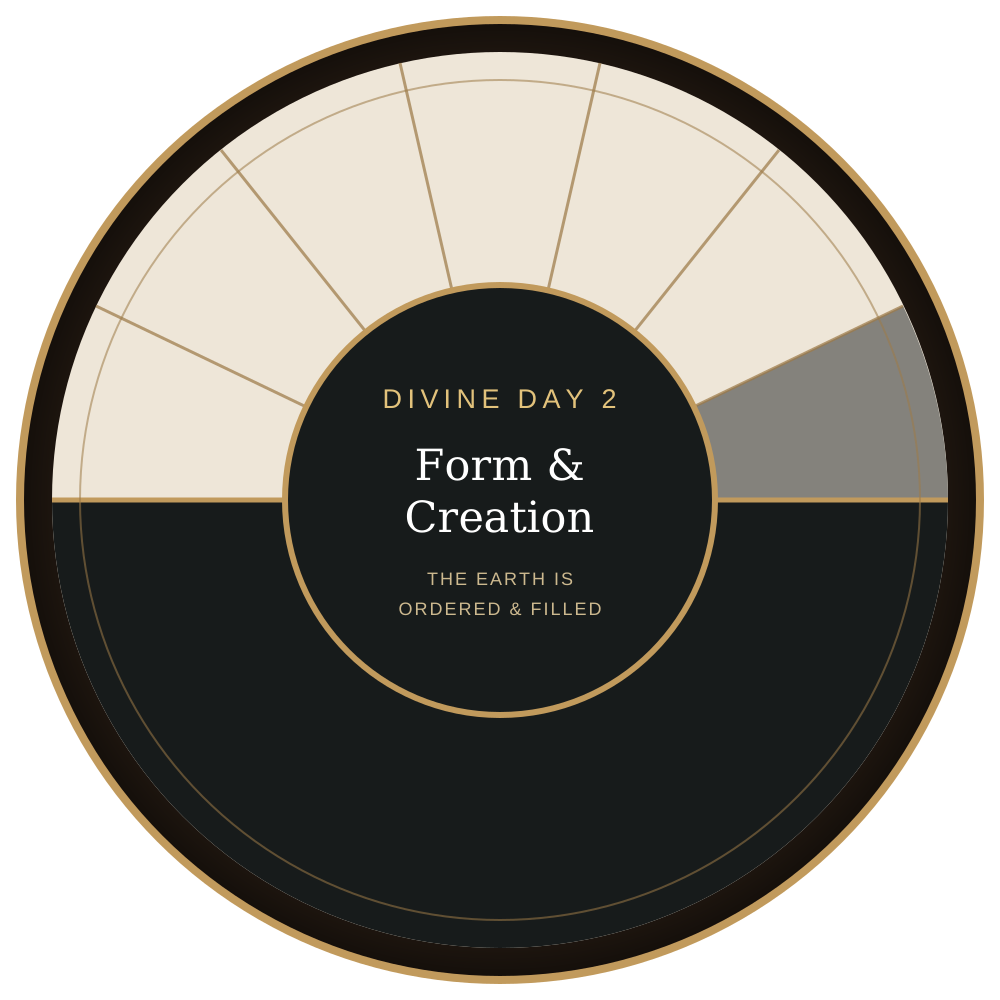
In full revelation, God forms, separates, fills, blesses, and completes His creative work. The morning unfolds through the seven Creation Days, reaching completion, sanctification, and rest at seven.
“Declaring the end from the beginning, and from ancient times the things that are not yet done…”ISAIAH 46:10 · KJV
Isaiah explicitly declares God’s knowledge and accomplishment of the end. The Wheel of Ages applies that statement to Creation Week: the beginning is read as a declared pattern that anticipates the end. The correspondence between seven Creation Days and later cycles of history is the study’s proposed synthesis, not a chronology explicitly stated in Isaiah.
Because the declared order reaches completion at seven, this study proposes that it cycles again on a corresponding scale. Completion becomes a threshold: the next Divine Day begins in evening, and the pattern returns through history.
Read Isaiah 46:9–10